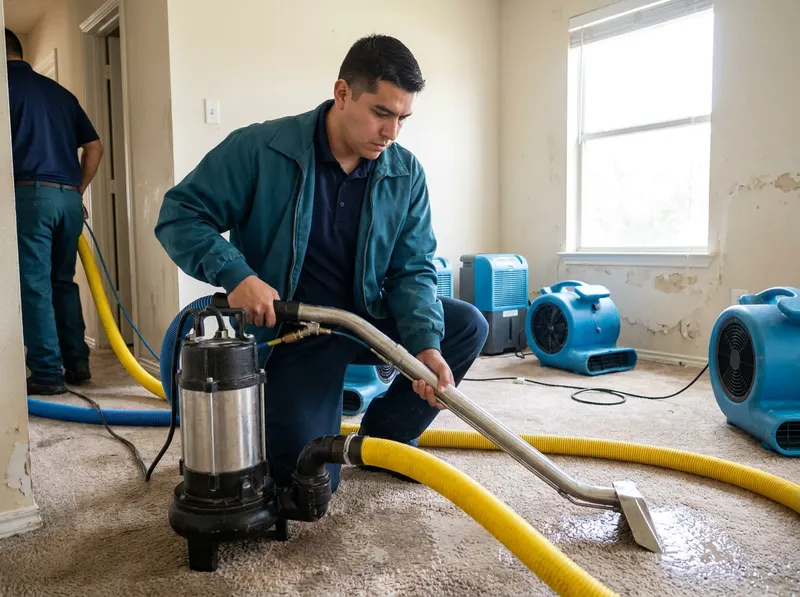
Frozen-pipe damage in Houston clusters around hard-freeze events, such as the February 2021 winter storm that burst supply lines across neighborhoods from The Heights to Clear Lake. Attics and exterior walls are the common failure points here because Houston homes are built for heat, not cold, pipe runs in unconditioned attic space above garages and in slab-edge walls freeze first when temperatures drop below 28°F for several hours. A single 1/2-inch supply line under pressure can release 5 to 8 gallons per minute, so a break that runs overnight floods multiple rooms before a homeowner notices.
Speed decides the cost. Water wicks into gypsum drywall at roughly 1 inch per hour and reaches subfloor and baseboards within the first day, and Category 3 microbial growth can begin inside 24 to 48 hours in Houston's humidity, which sits above 70% for much of the year. Extraction within the first few hours keeps a job in the drying-only tier; delayed response pushes it into demolition and reconstruction. Moisture meters and thermal cameras map the true wet zone behind walls, since visible staining underrepresents the spread by a wide margin.
The sequence runs in order: 1) confirm the water is shut off at the main; 2) extract standing water with truck-mounted or portable units; 3) remove saturated baseboards and drill weep holes or open wall cavities where trapped water sits; 4) set air movers and dehumidifiers, generally one air mover per 10 to 16 linear feet of wet wall; 5) monitor moisture daily until framing reads below 16% and drywall returns to a dry standard. A burst-pipe cleanup is not the plumbing repair, the pipe itself is re-soldered or replaced by a licensed plumber, while the cleanup crew handles the water, drying, and affected materials.
Decision-fit depends on how far the water spread. If a slow drip stayed under a single vanity or kitchen sink, a targeted extraction and 2-day dry-out is usually enough. If the break sat in an attic and water traveled down through the ceiling into a living room in a two-story home in Sugar Land or Pearland, expect ceiling removal, insulation replacement, and a longer 4-to-6-day drying cycle. Clean supply-line water is Category 1 and largely salvageable; if the burst mixed with sewage or sat for days, materials shift to Category 2 or 3 and more removal follows, the trade-off is faster material replacement versus longer drying to save existing walls.