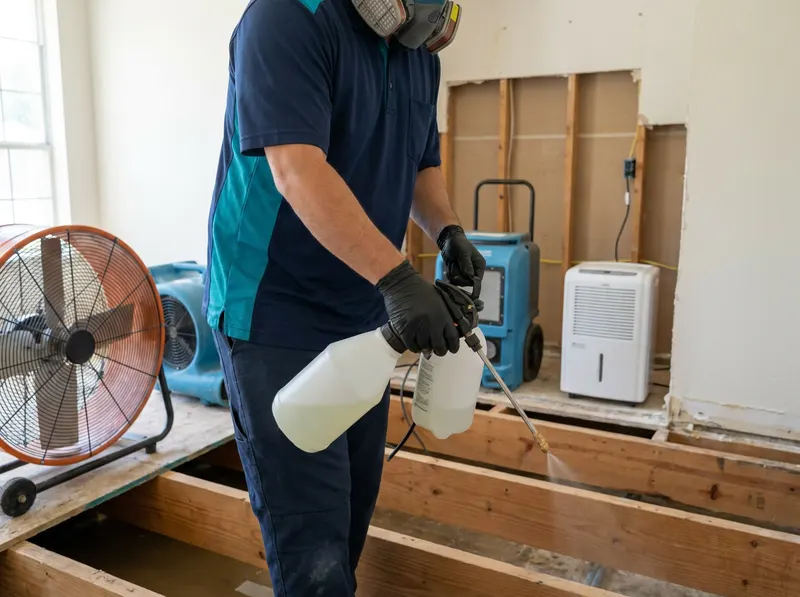
Houston's climate makes mold a fast follower of any water intrusion. Average summer relative humidity sits near 75%, and indoor mold can begin colonizing drywall within 24-48 hours of it staying wet. That short window is why prevention and remediation are treated as a continuum: dry the structure fast enough and remediation is avoided entirely; miss the window and the same area needs demolition, containment, and clearance.
Prevention is the correct scope when moisture is caught early and no visible growth exists, a slow supply-line drip under a Katy kitchen sink, or a slab-on-grade home in Meyerland taking on shallow water during a Brays Bayou overflow. The work is structural drying: extraction, air movers, and dehumidifiers run until wood framing reaches roughly 15% moisture content or lower. Remediation becomes the scope once mold is visible or a musty odor is present, common in older Heights bungalows with pier-and-beam crawlspaces and in Bellaire homes with sheetrock that sat damp after Harvey-era flooding. Remediation adds sealed containment, negative air pressure, and HEPA filtration to keep spores from spreading through the HVAC system during removal.
The process runs in a set order. First, a moisture meter and, where needed, a thermal camera locate wet cavities behind walls and under flooring. Second, plastic containment and negative-air machines isolate the work zone. Third, non-salvageable porous materials, drywall, insulation, carpet padding, are cut out and bagged. Fourth, remaining surfaces are HEPA-vacuumed and treated with an EPA-registered antimicrobial. Fifth, air movers and dehumidifiers dry the cavity, and a follow-up moisture reading confirms the target is met.
A key limitation: remediation clears mold, but if the source leak is not repaired the mold returns, so plumbing or roof repair is a separate step that precedes long-term prevention. Independent clearance testing by a third-party industrial hygienist is recommended for larger jobs; a passing air-sample result documents that spore counts have returned to a normal indoor level. The EPA advises professional remediation for mold covering more than about 10 square feet, which is the practical line between a DIY cleanup and a contained project.