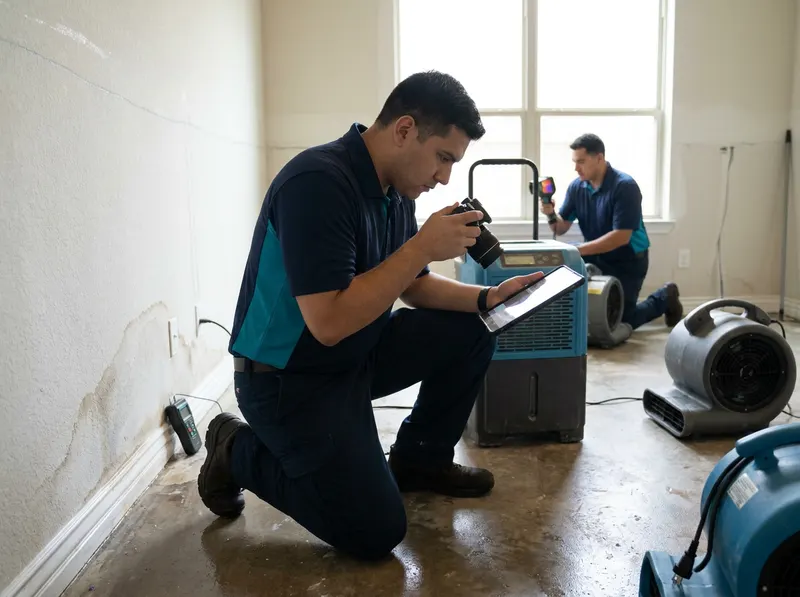
A water damage claim in Houston is decided on evidence, and carriers reviewing a loss look for four things: the source of the water, the date it happened, the area affected in square feet, and proof the property was dried rather than just wiped down. Documentation captures each of these as a discrete record. Moisture readings are logged with a meter reading in %WME (wood moisture equivalent) or %RH at the same spots each day, so an adjuster can see a wet wall reading 28% on day one drop to a dry-standard reading near 12-15% by day four. Category of water, clean supply-line loss, gray appliance discharge, or Category 3 sewage or floodwater, is noted because it changes what the carrier will and won't cover.
Houston's flood pattern shapes what the file needs to prove. Homes in Meyerland, Braeswood Place, and the Memorial neighborhoods along Buffalo Bayou often carry both a homeowner policy and a separate NFIP flood policy, and rising-water damage falls under the flood policy while a burst pipe falls under the homeowner policy. The documentation separates the water line height (measured in inches above the finished floor) from any interior plumbing failure, because a single job can involve two claims with two adjusters. Slab-foundation homes across Sharpstown, Alief, and Pasadena hold moisture in the bottom plate and subfloor after the visible carpet dries, so meter readings at floor level are recorded to justify continued equipment.
Decision-fit is straightforward: if the loss is a small clean-water event under one room and the deductible is close to the repair cost, a homeowner may pay out of pocket and a short photo record is enough; if the affected area crosses multiple rooms, involves Category 2 or 3 water, or exceeds the deductible by a wide margin, a full itemized loss file is what gets the claim paid without back-and-forth. The trade-off is time spent documenting on day one versus a stalled or reduced claim later, an adjuster who receives dated moisture logs and room photos approves faster than one asked to accept an undocumented estimate. Contents inventory lists each damaged item by room with an approximate age and pre-loss condition, which is how a carrier calculates actual cash value versus replacement cost.
The process runs in order: first, photograph the source and every affected surface before any material is removed; second, take baseline moisture readings and mark them on a floor sketch; third, place drying equipment and log its run hours daily; fourth, record readings at the same points each day until the dry standard is met; fifth, compile the readings, photos, inventory, and cause summary into one report matched to the carrier's claim number. Documentation is not the repair estimate, the estimate prices the rebuild, while the loss file proves the loss happened and was mitigated, and carriers require both.