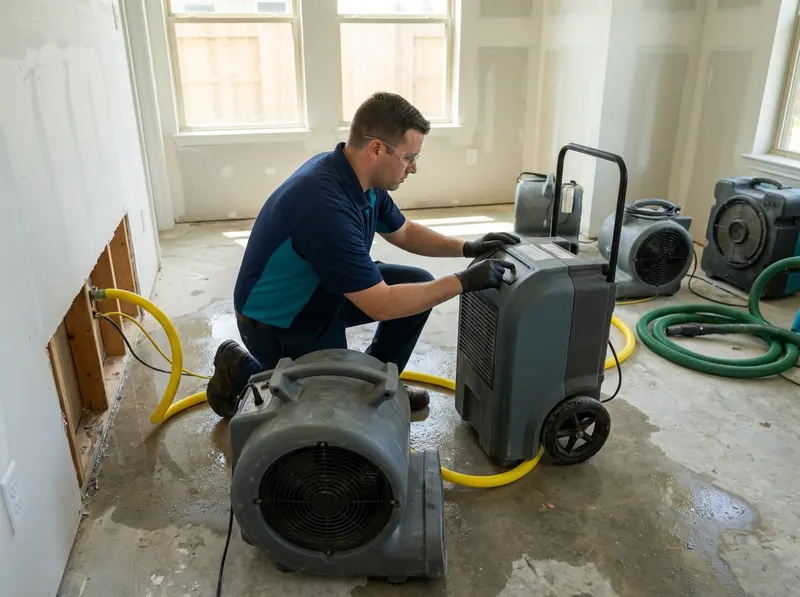
Structural drying targets the water trapped inside materials after visible pools are gone. A wet 2x4 stud can hold moisture at 20% or higher on a pin meter when a dry standard is 12, 16% for framing in the Gulf Coast climate. Air movers push a high-velocity sheet of air across wet surfaces to speed evaporation, while a dehumidifier pulls that airborne moisture out so it cannot re-condense on cooler walls. An LGR dehumidifier can pull humidity down to grain-depression levels a standard unit cannot reach, which matters in Houston where outdoor dew points sit in the 70s much of the summer and open-window drying does not work.
Decision-fit follows the material and how long it sat wet. If the water is clean, the floor is tile or sealed concrete, and drying starts within 24, 48 hours, in-place structural drying usually saves the assembly, technicians drill weep holes at the base of drywall or remove baseboard to move air into wall cavities rather than tearing out. If drywall stayed saturated past 72 hours, insulation is soaked, or the loss involves sewage from a backed-up line, controlled demolition of the wet section is the sound path and drying then protects the remaining structure. Bungalows in the Heights and older homes near Rice University often have shiplap or original hardwood over a pier-and-beam crawlspace; those cavities need airflow directed underneath, which extends the timeline compared to a slab home in Katy or Cypress.
Houston's flood exposure shapes the work. Homes near Brays Bayou, Buffalo Bayou and the Addicks and Barker reservoir pools saw slab-level water in past storm events, and concrete slabs release moisture slowly, a slab that read wet can take a week of continuous dehumidification and daily meter checks before framing plates sitting on it reach target. Rising interior humidity is also why a dehumidifier stays running the entire cycle, not just during business hours; shutting equipment off overnight lets moisture migrate back into dried framing and resets progress.
How the process runs, in order: 1) residual water is extracted and standing pockets are pulled from carpet pad or under cabinets; 2) moisture meters map the wet perimeter and a dry target is set per material; 3) air movers and dehumidifiers are positioned by the wet square footage and linear feet of wall; 4) readings are logged daily and equipment is repositioned as areas hit target; 5) equipment is removed once every mapped point reads dry, and the space is cleared for repairs. A dry-out is not the same as reconstruction, drying returns materials to a safe moisture level, while replacing drywall, flooring or trim is a separate repair phase.