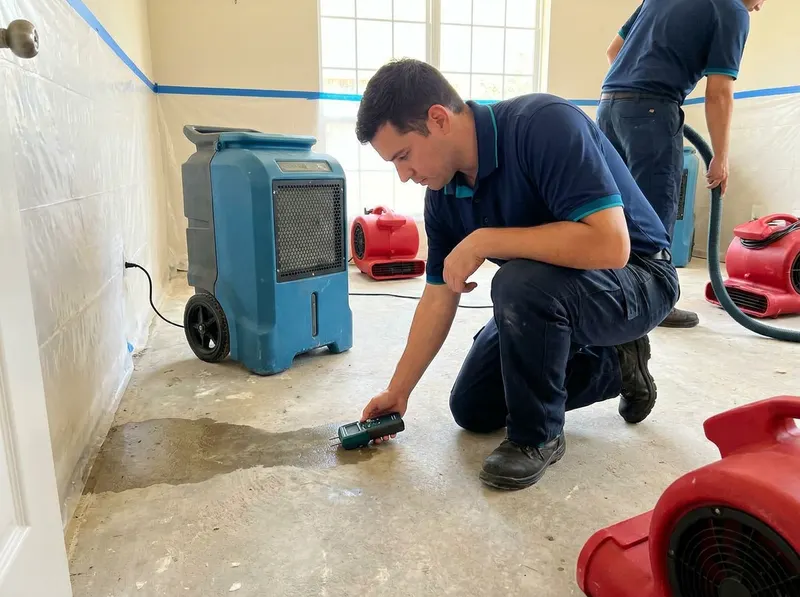
Houston sits on expansive clay soil that swells and shrinks with the region's wet-dry cycles, which stresses copper supply lines running under slab foundations across neighborhoods from the Heights to Sugar Land and Kingwood. A slab leak often shows up as a warm spot on a tile floor, an unexplained jump on the water bill, or the sound of running water with every faucet off. Sub-slab leak detection uses acoustic listening equipment and thermal imaging to pin the leak location before any concrete is opened, which limits how much slab has to be cut.
Drying the foundation is a separate step from repairing the pipe. After a plumber isolates or repairs the line, moisture migrates into the slab, the subfloor, and the bottom plates of interior walls. Moisture meters and a pinless scanner map how far the water traveled; readings are logged daily. Air movers create surface airflow while refrigerant or LGR dehumidifiers pull the released moisture out of the air, and the slab is dried to a documented standard rather than left to air-dry, which can take weeks in Houston's humidity and invite mold behind baseboards.
This service fits a confirmed or suspected under-slab leak; standing surface water from a burst supply line or an overflow is handled by general water extraction instead. If a floor is warm underfoot, water use is up, and the slab reads high on a meter, slab leak detection and foundation drying is the right path. If water is pooling on top of the slab from an appliance or a roof, standard extraction and structural drying apply. A single-room warm spot on a pier-and-beam home in the Heights is different from a full-slab ranch in Meyerland where moisture has spread under several rooms; the drying plan and equipment count scale with the wetted footprint.
Edge cases matter in Houston. Post-hurricane and flood-season leaks can be masked by broader water intrusion, so a full moisture map separates a slab leak from foundation seepage. Older Bellaire and Montrose homes with cast iron under the slab may need sewer-line camera work rather than a supply-line repair, which changes the drying timeline. Drying a slab under tile or engineered wood sometimes requires drilling small holes or lifting a section of flooring to reach trapped moisture, because sealed surfaces trap water beneath them.