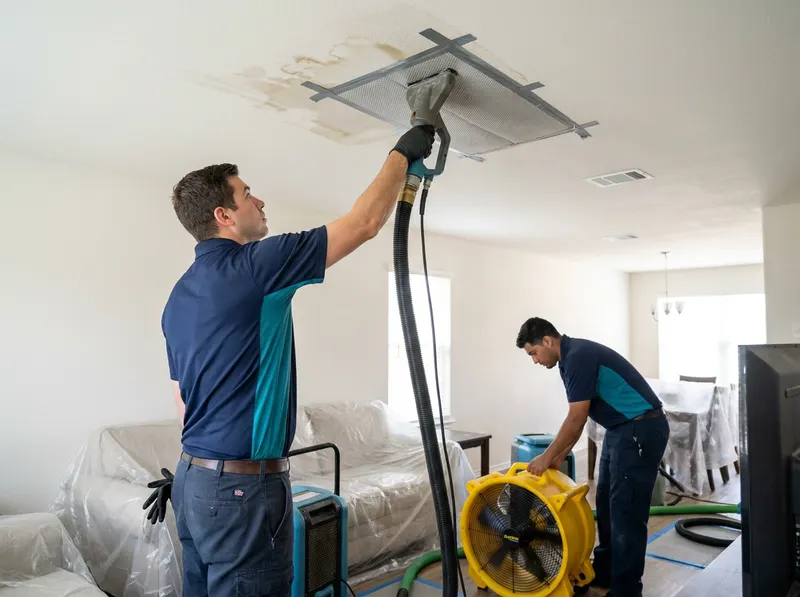
A roof or ceiling leak in Houston rarely stays where the stain appears. Water follows the top plate, rafters, and drywall seams, so a brown ring the size of a dinner plate in a Bellaire bungalow often sits under 30 to 60 square feet of wet insulation. Moisture mapping with a pin and pinless meter marks the true wet edge before any equipment runs, because drying only the visible spot leaves damp cavity framing that grows mold within 24 to 48 hours in Houston's summer humidity, which sits above 70% for much of June through September.
The drying sequence runs in plain steps. First, the active leak is stopped or tarped so no new water enters. Second, standing water and saturated blown-in insulation are removed from the attic where readings exceed a dry standard. Third, air movers are aimed across the ceiling plane and dehumidifiers are set to hold the room below 50% relative humidity. Fourth, moisture readings are logged each day until wood framing and drywall return to the dry baseline of the surrounding unaffected material. Drying the structure in place saves the ceiling when the drywall is only stained and still firm; when a panel sags, is spongy, or shows seam separation, that section is cut out rather than dried.
Source matters for what fits. Storm and hurricane roof damage across Houston, common after named systems tracking up from Galveston Bay, tends to soak wide attic areas and often pairs with roofing repair, so drying and a roofer run together. A slow plumbing leak from an upstairs bathroom in a two-story home in The Woodlands or Katy usually produces a tighter wet zone but can involve clean or gray water depending on the line. Clean-water ceiling leaks dry in place most reliably; contaminated-water leaks from a sewer line or long-standing roof intrusion may require removal of porous insulation and drywall for health reasons.
Houston's clay-heavy soil and flat-roof commercial stock add wrinkles. Older flat and low-slope roofs on Montrose and Midtown buildings pond water, so the wet area can be broad and shallow across a large ceiling. In attics with radiant barrier and dense-pack cellulose, meters read differently than in fiberglass, and the crew adjusts equipment runtime to match. A single-story home near NRG Stadium with a nail-pop leak is a fast job; a whole-attic soak after a hail event is a multi-day, multi-machine project.
Equipment is billed by the day, so drying that finishes in 3 days costs less than a 6-day job on a heavily saturated attic. The free on-site visit is where the wet-area size, water category, and drywall condition are confirmed, which sets the real number. Call and describe the leak, or text a photo of the ceiling stain.